Roth’s interview with Elizabeth Zott
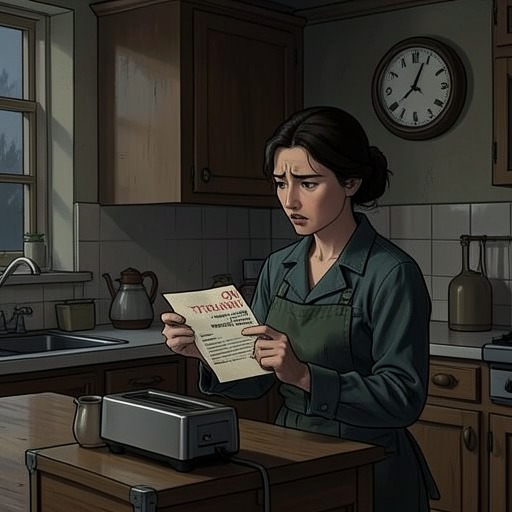
Lessons in ChemistryRoth’s interview with Elizabeth Zott turns on a breach of trust that unexpectedly opens onto the story she has kept private. Roth, a journalist interested in people rather than science, finds that Elizabeth’s identity cannot be separated from what she does; asking about Calvin Evans seems like his one way into the person behind the scientist. But when he takes that route, Elizabeth hears the question as a return to the old pattern of treating Calvin’s work as more important than her own life. The interview changes direction only after Roth stops trying to steer it and Elizabeth chooses to speak.
The Question That Breaks the Interview
Roth had been explicitly warned by Walter Pine not to ask about Calvin. He understood that crossing the line could end the interview badly, but decided to risk it anyway. His choice exposes the tension shaping the encounter: as a journalist, he wants access to the personal story that will make Elizabeth legible to readers; as her guest, he has been trusted to respect a boundary. His question about Calvin turns that tension into an immediate conflict.
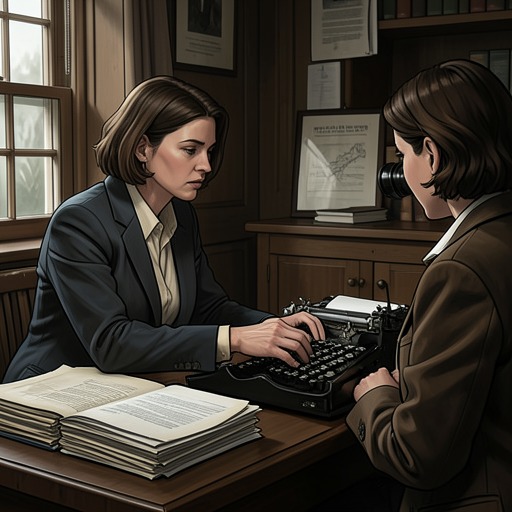
At the mention of Calvin’s name, Elizabeth whips around and looks at Roth with disappointment. Her long, searching look registers the question not as neutral curiosity but as a broken promise. She flatly accuses him of being more interested in Calvin’s work. The photographer reads the moment as a failure, shakes his head at Roth, puts on his lens cap, and leaves for the outside. The interview has ceased to be a routine exchange: Roth’s attempt to get closer has made the people present withdraw from him.
Roth insists that he is interested not in Calvin’s work but in Elizabeth and Calvin’s relationship. That clarification does not immediately repair the damage. The scene instead gives weight to the difference between a journalist’s stated intention and the subject’s experience of being questioned. Roth has gained Elizabeth’s trust and then, in his own later judgment, trampled it; the fact that he wants a personal account does not erase how his question has made her feel.
Silence and a Change of Direction
After the confrontation, they sit for a long time. Their coffee grows cold, and even the ticking of Elizabeth’s Timex seems to lose its enthusiasm. Outside, a horn sounds and a woman calls out that she has said the same thing a thousand times. These details extend the pause without turning it into reconciliation: the interview has stalled, and Roth is left with what he has done.
The narration makes clear that Roth’s silence is not a calculated journalistic technique, though he knows the truism that a subject may begin speaking when a reporter stops asking. He remains quiet because he hates himself for crossing a line after Walter warned him not to. He wants to apologize, but understands that words alone are inadequate to a true apology. The distinction matters to the scene’s turn: Elizabeth does not resume the interview because Roth has talked his way back into her confidence.
A siren suddenly screams past, and Elizabeth startles like a deer. Then she leans forward and reopens Roth’s notepad. She asks, “You want to know about Calvin and me?” and begins to tell him the bare truth. The gesture is hers: the notepad that had been closed by the photographer’s departure is opened again by Elizabeth. She grants access on her own terms, shifting the encounter from Roth’s pursuit of a story to her decision to tell one.
Elizabeth’s Account of Calvin
Elizabeth begins, “Calvin and I were soulmates.” Her account presents their connection as a rare collision rather than a conventional attraction. She describes Calvin as awkward and moody and says that they did not simply click; they collided, literally, in a theater lobby, where he vomited on her. The comic indignity of their first encounter stands beside the intensity with which she remembers their love, giving the story an origin both bodily and expansive.
She invokes the big bang theory and explains that an advanced understanding of chemistry is unnecessary to appreciate how unusual their situation was. The analogy is more than a flourish: in her telling, scientific language is the language through which she can make the scale of the relationship understood. She goes on to describe their affair using terms such as expansion. The interview therefore does not ask her to set aside her identity as a scientist to speak about love; instead, she makes chemistry and cosmology part of how she communicates its force.
Significance of the Encounter
The interview marks a shift in what Roth is able to hear about Elizabeth. At first, his effort to reach the person behind her scientific work repeats the very diminishment she objects to: he brings Calvin into the conversation, and she suspects that his interest will settle on Calvin rather than on her. Her account, once she elects to give it, makes their relationship inseparable from her own voice and perspective. Calvin is central to the story she tells, but Elizabeth is its narrator and interpreter.
The scene also distinguishes disclosure from journalistic entitlement. Roth’s access comes only after he stops asking, recognizes the harm he has caused, and leaves room for Elizabeth to reopen the conversation. His inability to know what to do with the truth she gives him underscores that receiving a story is not the same as mastering it. The interview’s decisive movement is consequently not simply from professional questions to private history: it is from a reporter’s attempt to obtain intimacy to Elizabeth’s deliberate act of telling, beginning with her own account of how she and Calvin collided.